Mutual funds investment

Contains:
- Mutual Funds Investment
- Useful Terms
- Index Funds & ETF
- Mutual Funds
- Debt Mutual Funds
- Hybrid Mutual Funds
- Equity Mutual Funds
- Fund of Funds
Useful Terms :
- NAV – Like stock price for mutual fund (price per share). NAV may or may not be an indicator of performance, but only return is. Low NAV may or may not be better for investor
- Expense Ratio – Annual Fee charged by Fund Managers daily. This is brokerage. Already adjusted in NAV (Returns). It affects on the day to day return instead of end day detection.
- AUM – Asset under Management. More AUM means trusted by public (except smallCaps)
- Exit Load – Charges on fund withdrawal
Index Funds & ETF
If you are planning for a Long term investment option Index fund is the best.
Companies grouped together and called as a index. Can be based on top companies or sector wise.
Lower market cap indices higher the risk higher the return. Nifty 50 is a popular index
An ETF – Exchange Traded Fund, tracks an index and is tradable
One cannot directly invest in a index. But can buy index mutual funds that track the returns of the index. These mutual funds invest in the companies listed in index according to its weight in the index and thereby tracking the returns and hence become passive investment option.
Things to see before investing in a index fund:
- Lower Tracking error
- Higher AUM
- Lower Expense Ratio
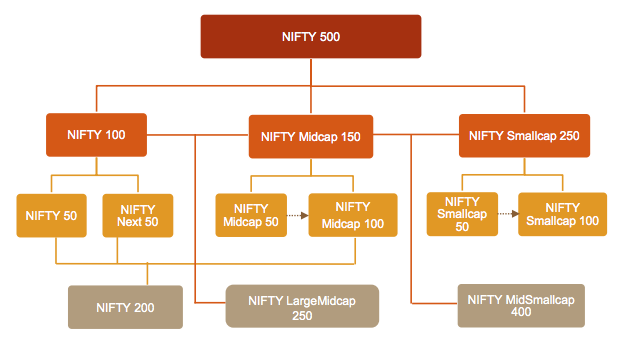
Here are the indices based on market cap,
Mutual Funds Investment
Mutual fund Plans
Growth : Dividend and returns reinvested in the same mutual fund
ICDW : Income Distribution cum capital withdrawal. Dividend given to investor periodically. IDCW is not tax benefit. Also the dividends are not from the underlying stocks but by a portion of NAV, and therefore dividends can lower the return.
Direct : Funds directly purchased. Lower Expense Ratio
Indirect / Regular : Funds purchased through broker
- Opt for Growth and Direct model
Factors to see before buying a mutual fund
- High AUM
- NAV
- Low Expense ratio
- Low exit load
- Peers & portfolio
Mutual Funds Investment
- Debt Mutual Funds
- Hybrid Mutual Funds
- Equity Mutual Funds
Debt Mutual Funds
Bonds vs Equity
Bonds: Lending money to bond issuer for interest. No ownership
Equity: Share in the ownership of the company
Risks Associated
– Credit Risk : Company ran out of money. mostly not possible since many companies are there. Defaulting risk.
– Interest Rate Risk : Banks FD interest rates become greater than debt interest rate in the promised tenure. Debt manager sells older debt in discount and get new bonds for higher interest rate. Price slightly drops. https://youtu.be/WAqLZe-iEWA?feature=shared
– Liquidity Risk : If sellers outnumber buyers significantly in the bond market. Debt manager sells debt in discount before maturity, making the value low overall
– Inflation Risk : Returns less than inflation rate.
Debt holdings that a mutual fund can possibly have
- Treasury Bills (T-Bills) – Money market instrument issued by government. Issued to raise short term funds. Bought at a discount and sold at the face value.
- TREPS (Tri-party REPo dealing and settlement System) – Managed by CCIL. Involves borrower, lender and CCIL. Issued to raise fund within a day using g-sec like T-Bills as collateral. Very short term and highly liquid.
- G-Sec (Government Securities) – Long/Short term Gov bonds
- Corporate Bonds
- Reverse Repo – Excess funds lend to RBI at reverse repo rate in exchange for gov securities. For a short term
- CBLO (Collateralized Borrowing and Lending Obligation) – Secured short term loan using g-sec as collateral. Today TREPS does the same job in more efficient way.
- CD (Certificate of Deposit) – Generally TD (Time Deposit) is the general term used globally and both FD and CD are TD. FD is a form of time deposit popular in India. CD is like a FD that is tradable. Used by large investors for short term investments
- Non convertable Debentures – Loans raised by companies that cannot be converted as shares of the company
- Comercial Paper – Short term unsecured debt instrument issued by companies to raise funds for mostly working capital needs
- Net Receivables/Payables – Represents accrued interest or settlements pending. Can give insights on liquidity
- Floating rate notes – A debt instrument where the intrest rate varies according to a benchmark
- Net current assets – A portion of funds NAV that is held in cash or equalents after accounting for liabilities not tied up in the securities like bond or money market instruments. For liquidity.
- Zero Coupon Bonds – Bought at a discount and sold at face value. Can be issued by government or corporate.
Notes
– Repo rate is the interest rate offered from RBI to other banks. Coupon rate is rate of interest of the debt instrument.
– Higher the maturity period of the bond higher the interest rate risk
– Bonds price decrease if FD interest rate increases since new bonds issued becomes more attractive with higher interest rate. Shorter the duration of debt funds the easier it can adapt to the newer attractive bonds without loss in price.
– Lowering interest rate (repo related rates) leads to lowering of FD rates
– Gov bonds has less credit risk, but they have around 10yr maturity period usually
– Choose Bonds if you want lower risk than equity, or to diversify or for stable dividends without risk at retirement. The returns are lower than equity.
– Choose bond that match your investment goal time period, since maturity periods are different for each funds.
– For shorter duration bonds : Longer the time invested, lower the return. Need to adopt strategy like FD laddering.
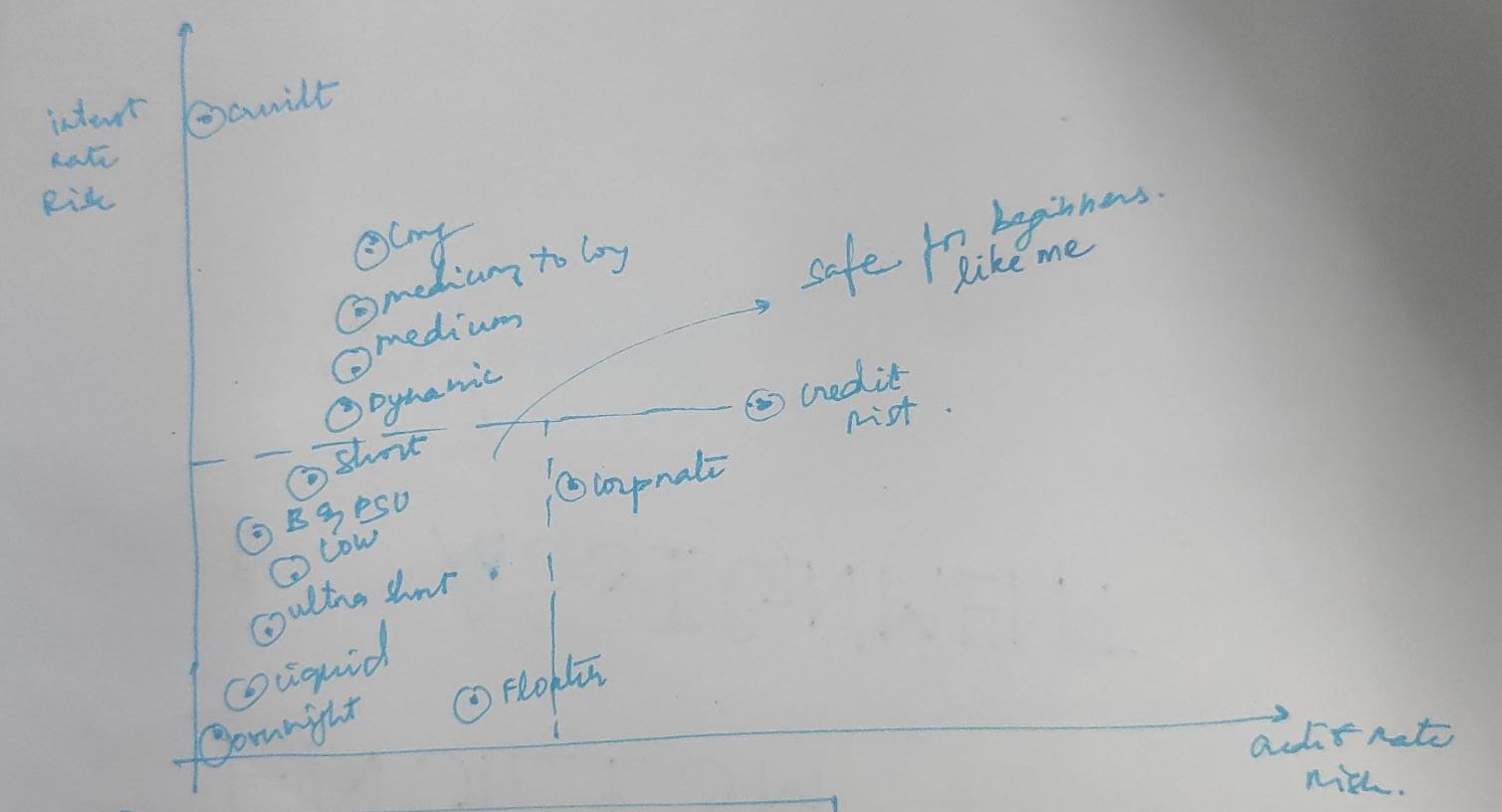
Debt funds are in form of debt mutual funds
Types ( SEBI Classified )
- Overnight Debt Funds
- maturity period 1 night
- high liquidity
- low exit loads
- Liquid Funds
- maturity period 3 months
- high liquidity
- low exit loads
- Ultra Short Duration Funds
- maturity period 3-6 months
- Low Duration Funds
- maturity period 6-12 months
- Short Duration Funds
- maturity period 1-3 years
- Medium Duration Funds
- maturity period 3-4 years
- Medium to Long Duration Funds
- maturity period 4-7 years
- Long Duration Funds
- maturity period >7 years
- Dynamic Bond Funds
- Dynamic maturity period
- bond selection based on FD interest rate bets
- Gilt Funds
- 80% gov bonds and 20% others
- Corporate Bond Funds
- 80% others and 20% gov bonds
- maturity period 3-5 years
- Banking and PSU Debt Fund
- PSU – Public Sector Undertaking – Company where majority share is held by government
- 80% Banking and PSU Companies and 20% others
- maturity period 2-3 years
- Credit Risk Funds
- 65% high risk companies
- Floater Funds
- investment on floating rate instruments
- Lower interest rate risk
- used to capitalise on rising interest rate with low volatility
Hybrid Mutual Funds
Types:
Arbitrage Funds
- funds based on intra-market differences
- short term
- tax benefit like equity
- FD like minimal returns & not risky
Conservative Funds
- 80% debt & 20% equity
- short term
Equity Savings
- Equity + Arbitrage + Debt
Balanced Funds
- 60% debt 40% equity
Aggressive
- 80% equity & 20% debt
- tax benefit & risky
- long term
Multi Asset
- Equity + Debt + Others (like gold, etc.,)
Dynamic Asset Allocation
- Adjust equity & debt assets according to market condition
- Also called balanced Advantage
- Long Term
Equity Mutual Funds
https://youtu.be/3DlRb3z5ccU?feature=shared
1. Based on Market Capitalization
- Large-Cap Funds
- Mid-Cap Funds
- Small-Cap Funds
- Multi-Cap Funds
- Flexi-Cap Funds
2. Based on Investment Style
- Value Funds
- Growth Funds
- Focused Funds
3. Based on Theme or Sector
- Sectoral Funds
- Thematic Funds
4. Based on Geography
- International/Global Funds
5. Tax-Saving Equity Funds
- ELSS (Equity-Linked Savings Scheme)
6. Based on Market Trends
- Contra Funds
- Dividend Yield Funds
Last updated: September 20, 2026